

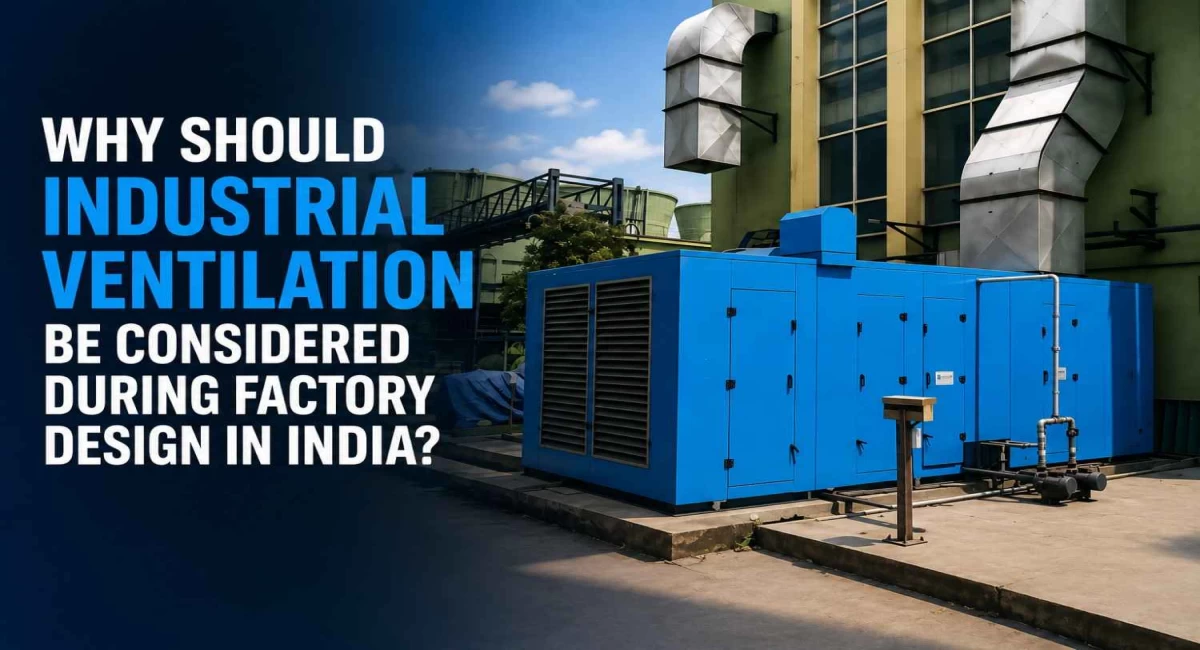
Why Should Industrial Ventilation Be Considered During Factory Design In India?
Before Your Read
- Plan industrial ventilation before finalising the factory building layout.
- Identify heat, dust, fumes, and vapour sources early.
- Use local exhaust near major contamination sources.
- Coordinate ducts with machines, structures, electrical systems, and access.
- Match ventilation equipment with actual factory production needs.
- Review applicable Indian workplace and environmental requirements.
- Plan maintenance access before installing ventilation equipment.
Have you ever wondered why industrial pressurisation and ventilation systems should be planned before a factory starts operating? A factory needs more than machines, power, storage, and production space.
It should form part of factory design from the early planning stage. Good ventilation supports worker safety, better indoor conditions, equipment performance, and smoother production.
What Is Industrial Ventilation in a Factory?
It is the planned movement of air inside a factory. It removes unwanted air and brings cleaner air into work areas.
This can control several workplace conditions, such as:
- Excess heat from machines and production processes
- Dust from cutting, grinding, mixing, or handling materials
- Fumes from welding and other processes
- Chemical vapours and gases
- Smoke and airborne contaminants
- Moisture and unpleasant odours
- Stale air in enclosed work areas
Why Should Industrial Ventilation Be Planned During Factory Design?
It works best when designers consider it before construction begins. Late changes can affect the building layout, duct routes, equipment locations, electrical work, and roof structure.
It Helps Control Workplace Heat
Factories often generate high heat through furnaces, ovens, boilers, compressors, motors, and other equipment. Workers can face uncomfortable conditions when this heat stays inside the building.
It Controls Dust and Airborne Contaminants
Dust can come from several factory activities. Cutting, grinding, crushing, polishing, mixing, and material handling can release particles into workplace air.
It Helps Manage Welding Fumes and Process Fumes
Welding and some manufacturing processes release fumes and gases. Workers can come close to these sources during regular operations.
How Does Ventilation Affect Factory Layout?
Factory layout and ventilation have a close connection. Machines, workstations, storage areas, doors, windows, and exhaust points affect air movement.
What Should Designers Consider?
The design team should review:
- Production machines and their locations
- Heat-producing equipment
- Dust and fume sources
- Worker movement and workstations
- Raw material and finished-goods storage
- Ceiling height and building volume
- Fresh-air intake locations
- Exhaust discharge locations
- Maintenance access
- Electrical and structural requirements
Can Natural Ventilation Replace Industrial Ventilation?
Natural ventilation can work well in some factory areas, but it cannot solve every ventilation problem.
Windows, louvers, roof ventilators, and openings can support air movement. Their performance depends on building design, outdoor conditions, wind direction, temperature differences, and the factory process.
Factories with significant dust, fumes, gases, or high heat often need mechanical ventilation. Local exhaust systems may also be required near specific sources.
Why Is Local Exhaust Ventilation Important?
Local exhaust ventilation captures contaminated air before it spreads through the workplace. This makes it different from general air circulation.
Suppose a grinding machine produces fine dust. A nearby extraction hood can capture dust close to the grinding point. The contaminated air then moves through ductwork to suitable filtration or treatment equipment.
This method can reduce the amount of contaminated air that enters the wider factory space.
How Does It Support Worker Safety?
Workers spend long hours inside industrial buildings. Poor air conditions can affect comfort and workplace safety.
Excess heat can create difficult working conditions. Dust and fumes can reduce air quality. Poor airflow can also allow contaminants to remain around occupied areas.
A suitable ventilation system controls these conditions at their source or through general air movement. It should work with other safety measures used at the factory.
How Does Ventilation Affect Factory Equipment?
Factory equipment can also suffer from poor environmental conditions. Dust can settle on machines, electrical panels, filters, motors, and sensitive components.
High heat can also affect operating conditions for certain equipment. Moisture and corrosive substances can create further problems in some industrial environments.
A suitable ventilation system can control heat, dust, moisture, and contaminated air around relevant areas.
What Should Indian Factories Consider Before Selecting a System?
Indian factories operate across different climates and production conditions. A factory in Delhi may face different outdoor conditions from one in Chennai or Mumbai.
Designers should consider the local climate, building orientation, production process, seasonal conditions, and outdoor air quality.
They should also review applicable factory, workplace safety, building, fire safety, and environmental requirements.
What Are Common Design Mistakes?
Some ventilation problems begin during the design stage. Common mistakes include:
- Choosing fans before studying the production process
- Relying only on general air circulation
- Placing exhaust points far from pollution sources
- Ignoring duct routes during building design
- Blocking fresh-air intake locations
- Providing poor access for maintenance
- Ignoring future production expansion
- Failing to coordinate ventilation with electrical and structural work
How Can Factory Owners Plan Ventilation Correctly?
Start with the production process rather than the equipment catalogue. Identify every major source of heat, dust, fumes, vapours, and gases.
Then divide the factory into suitable ventilation zones. Decide where workers need cleaner air and where contaminants need source capture.
A practical planning process includes these steps:
- Map the production process.
- Identify heat and contamination sources.
- Review worker locations and movement.
- Select suitable ventilation methods.
- Plan fresh-air and exhaust points.
- Coordinate ducts with the building structure.
- Select suitable fans and air-cleaning equipment.
- Plan inspection and maintenance access.
- Review applicable Indian requirements.
- Test and balance the completed system.
Why Should Ventilation Be Part of the Initial Factory Budget?
Adding ventilation after construction can create extra work. Contractors may need to modify walls, roofs, electrical systems, ceilings, or machine layouts.
Early planning gives the project team time to coordinate these requirements. It also allows the owner to compare different system options before purchasing equipment.
The initial budget should cover fans, ducts, filters, hoods, supports, controls, electrical work, installation, testing, and future maintenance.
The Bottom Line
Not just ventilation but bag filter manufacturers should also become part of factory design from the beginning. It controls heat, dust, fumes, and stale air at suitable points. A planned system also supports worker safety, equipment care, and smoother production. For Indian factories, the design should match local conditions, production needs, building layout, and applicable requirements.