

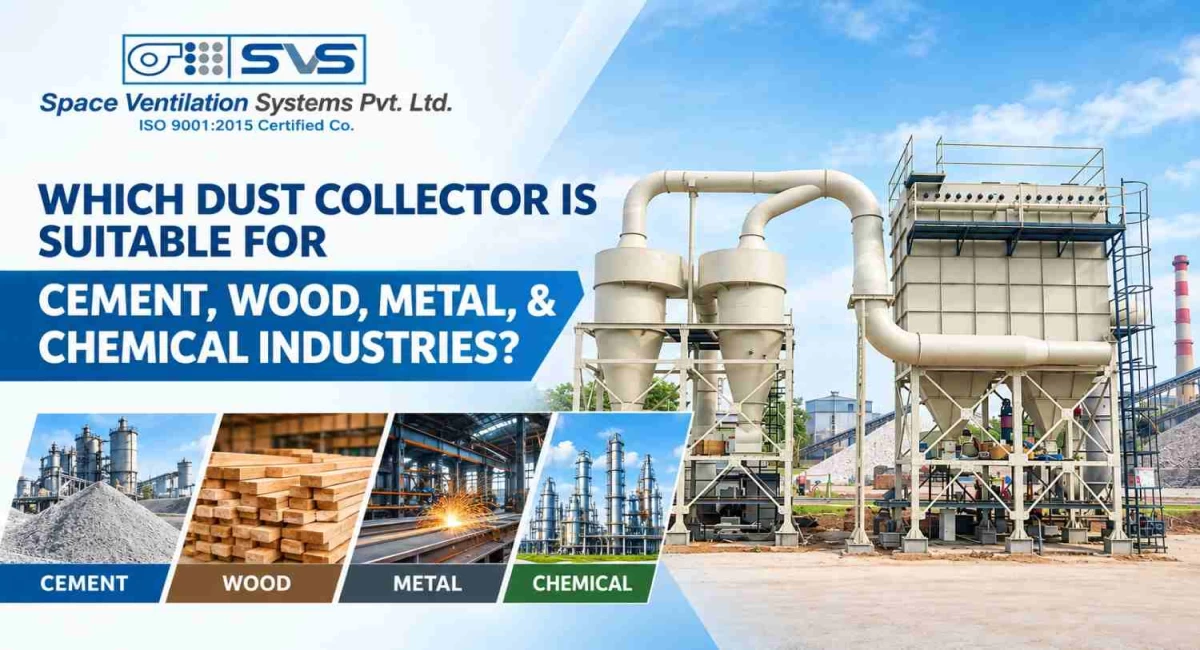
Which Dust Collector Is Suitable For Cement, Wood, Metal, & Chemical Industries?
Featured Highlights
- Baghouse collectors suit several cement dust applications.
- Cyclones can handle larger wood particles effectively.
- Metal processes may need dust or fume extraction systems.
- Chemical plants need filters that suit material properties.
- Airflow and particle size guide collector selection.
- Combustible dust requires careful safety planning.
Are you unsure which dust collector is suitable for your industrial process? The right choice depends on the type of dust, particle size, production process, air volume, and safety needs. It must match the material and working conditions.
A dust collection system removes dust from industrial air before it spreads across the workplace. Different industries produce different types of dust.
Cement plants handle fine mineral dust.
Wood units produce chips and fine wood particles.
Metal plants can produce dust, fumes, and grinding particles.
Chemical plants can handle fine powders and process dust.
We are one of the best cyclone dust collector manufacturers in the industry, and we would like to share our experience in this article.
Which Dust Collector Is Suitable for Cement Industries?
A baghouse dust collector is widely suited to cement industry applications. It can handle large dust loads and fine cement particles. It works well at points such as crushers, mills, conveyors, silos, and packing areas.
Cement dust contains fine mineral particles. These particles can spread through plant areas if the system does not capture them at the source. A baghouse uses filter bags to separate dust from the air.
The required system depends on the air volume and dust load. The filter material also matters. Cement plants often need filter media that can handle fine dust and the plant temperature.
Cyclone dust collectors can also work in cement applications. They are useful for larger particles and can act as a pre collector. A cyclone alone may not provide enough filtration for very fine cement dust.
Which Dust Collector Is Suitable for Wood Industries?
Woodworking units usually need a cyclone dust collector, baghouse dust collector, or cartridge based system. The right option depends on the type of wood waste and the process.
Saws, planers, routers, and sanding machines can release chips and fine dust. Larger wood chips need a system that can handle high particle loads. Fine sanding dust needs better filtration.
A cyclone dust collector can separate larger wood particles from the air. It can work well as the first stage of a wood dust collection system. A bag filter can then capture finer particles.
Wood dust also needs careful handling because combustible dust can create fire and explosion risks. The system design must consider the type of wood, dust concentration, spark risk, and plant layout.
Good airflow also matters. Poor duct design can allow dust to settle inside the system. The collector must match the number of machines connected to it.
Which Dust Collector Is Suitable for Metal Industries?
Metal industries may need different dust collectors for different processes. Grinding, cutting, polishing, welding, and casting can create different forms of airborne pollutants.
A cartridge dust collector can suit fine dry metal dust from grinding and polishing. A wet scrubber can suit certain metal fumes and process gases. A baghouse can suit larger industrial dust loads when the process conditions support bag filtration.
Metal dust can also create special safety concerns. Some metal dusts can burn or create explosive conditions. Aluminium and magnesium dust require particular care because their dust can be highly combustible.
For welding operations, a fume extraction system can be more suitable than a standard dust collector. It captures welding fumes close to the source.
A metal processing plant should not select a collector only by its filter size. The dust properties and process conditions should guide the system design.
Which Dust Collector Is Suitable for Chemical Industries?
They often require careful dust collector selection. Chemical processes can produce fine powders, fumes, corrosive particles, and other process pollutants.
A baghouse can suit several dry powder applications. Cartridge collectors can work well for fine particles when the dust and temperature suit the filter media. Wet scrubbers can suit certain gases, fumes, and particles that need liquid based treatment.
Chemical dust can also react with filter materials or other substances. The collector design must match the chemical properties of the material.
A chemical plant may also need special construction materials. Stainless steel or protective coatings can suit certain corrosive environments. The final design depends on the actual process and chemical exposure.
How Do You Choose the Right Industrial Dust Collector?
The right industrial dust collector starts with the dust itself. You should not select a collector based only on the industry name. Two plants in the same industry can have different dust collection needs.
Start with the following factors.
- Dust Type
- Particle Size
- Airflow Requirement
- Temperature
- Moisture
- Dust Load
- Safety
- Maintenance
What Are the Common Dust Collector Options in India?
Industrial plants in India use several dust collection technologies. Each type has a specific role.
A cyclone dust collector uses centrifugal force to separate larger particles from air. It often works as a pre separator.
A baghouse dust collector uses filter bags to capture dust. It suits several heavy duty industrial applications.
A cartridge dust collector uses pleated filter cartridges. It can provide a large filter area within a compact design.
A wet scrubber uses liquid to remove selected dust, fumes, or gases. It can suit processes where wet treatment is acceptable.
An electrostatic precipitator uses electrical charges to collect fine particles. It is used in large scale industrial applications where process conditions support this method.
Summing Up
The suitable dust collector depends on the material, process, airflow, temperature, and safety needs. Cement plants often use baghouse systems. Wood industries can use cyclones and bag filters. Metal plants may need cartridge collectors or fume systems. Chemical plants may use bags, cartridges, or wet scrubbers. Choose the dust collector after checking actual process conditions.
You can also contact us for APCD devices, since we are an air pollution control device manufacturer too.