

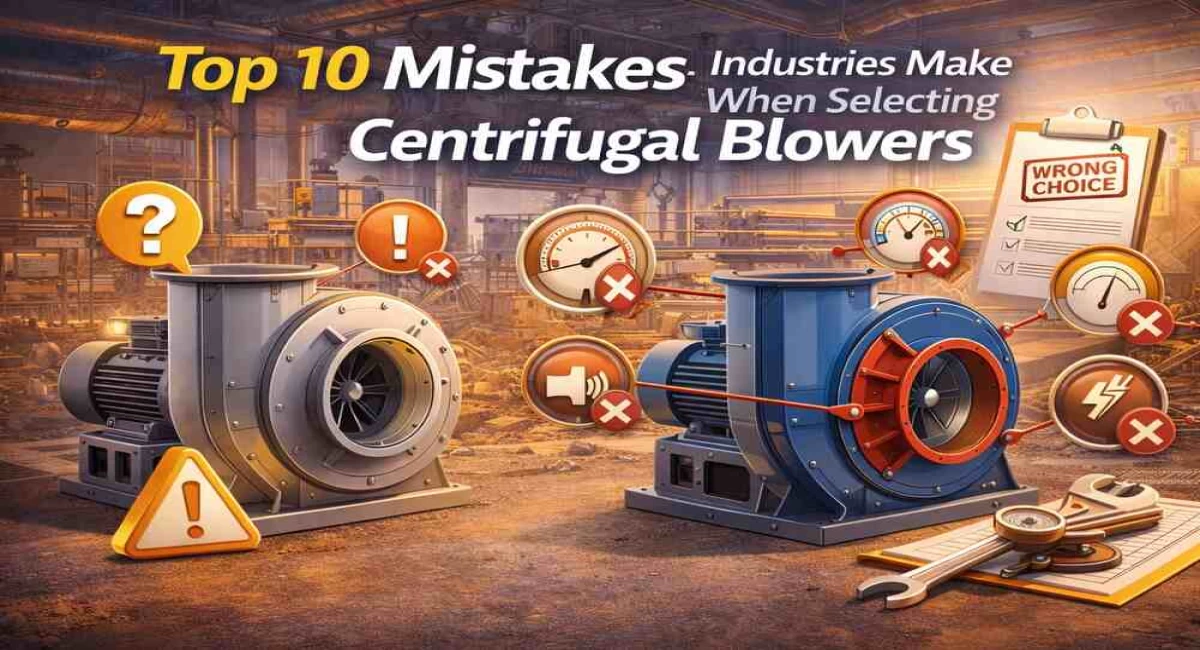
Top 10 Mistakes Industries Make When Selecting Centrifugal Blowers
Have you ever wondered why some centrifugal blowers fail early or dont deliver the performance industries expect? Many businesses assume all blowers work the same.
When industries search for centrifugal blowers, they often ask similar questions. How do you choose the right blower capacity? What specifications actually matter? How do operating conditions affect performance? And what hidden mistakes increase long term costs?
A centrifugal blower is a mechanical device that moves air or gas using rotating impellers. It converts mechanical energy into airflow and pressure. Industries rely on it for ventilation cooling drying and material handling.
Key Takeaways
• Accurate airflow and pressure calculations prevent performance issues
• Energy efficiency reduces long term operating costs
• Proper material selection protects equipment life
• Noise vibration and maintenance access affect reliability
• Strong manufacturer support improves long term performance
• Planning for growth avoids repeated equipment replacement
Why Avoiding Centrifugal Blower Selection Mistakes Saves Time and Money?
Choosing the right centrifugal blower directly affects your daily operations. A poor selection can cause energy waste system downtime and expensive repairs. That means lost productivity and higher running costs.
When you understand common selection mistakes you make smarter decisions. You improve airflow performance extend equipment life and reduce unexpected failures.
10 Mistakes Industries Make When Selecting Centrifugal Blowers
Ignoring Actual Airflow Requirements in Centrifugal Blowers
Many industries guess airflow needs instead of calculating them properly. They rely on rough estimates or past equipment sizes. This often leads to underperforming or oversized systems.
When airflow does not match process demands the blower struggles. It may consume excess power or fail to maintain pressure.
Overlooking Static Pressure and System Resistance
Some buyers focus only on airflow and forget system resistance. Duct length bends filters and obstructions increase static pressure. These factors strongly influence blower performance.
If the blower cannot overcome resistance airflow drops sharply. The system becomes inefficient and noisy.
Choosing Based Only on Initial Price
Price often drives quick decisions. Industries sometimes select the cheapest centrifugal blower to reduce upfront spending. This approach ignores long term operating costs.
Low-cost units may consume more energy and require frequent maintenance. Over time they cost far more than efficient models.
Ignoring Energy Efficiency Ratings
Energy efficiency plays a major role in industrial operations. Some companies skip efficiency comparisons and focus only on capacity. This increases electricity consumption.
Efficient centrifugal blowers reduce power usage and heat generation. They support sustainability goals and lower utility bills.
Mismatching Materials with Operating Environment
Industrial environments vary widely. Some involve moisture chemicals or high temperatures. Selecting the wrong construction material causes corrosion and wear.
A blower exposed to harsh conditions must use suitable materials. Stainless steel or coated components may be necessary.
Neglecting Noise and Vibration Factors
Noise and vibration affect worker comfort and equipment stability. Many industries ignore these factors during selection. They focus only on airflow and pressure.
Excess vibration leads to mechanical stress and early failure. High noise levels create safety concerns. Evaluating acoustic data and mounting design prevents these issues.
Failing to Consider Maintenance Accessibility
Maintenance access is often an afterthought. Some blower installations make servicing difficult. This increases downtime and labor effort.
A well-designed centrifugal blower allows easy inspection and part replacement. Accessible components simplify routine maintenance.
Overlooking Manufacturer Support and Service
Reliable support matters after purchase. Some industries choose suppliers without checking service availability. When problems occur, help becomes hard to find.
Manufacturers with strong technical support provide guidance spare parts and training. This reduces downtime and improves reliability.
Ignoring Future Expansion Needs
Operations often grow over time. Selecting a blower only for current demand limits flexibility. Upgrades then require full replacement.
Planning for moderate expansion allows scalability. A slightly higher capacity system can support future growth.
Skipping Proper Testing and Performance Verification
Some industries install centrifugal blowers without thorough testing. They assume factory specifications will match site conditions. Real environments often differ.
Performance testing confirms airflow pressure and efficiency. It identifies installation issues early. Verification ensures the system works as intended.
Final Words
Selecting centrifugal blowers and industrial scrubber system is not just a technical task. It directly shapes operational efficiency costs and reliability. Many common mistakes come from rushing decisions or ignoring system details.